
By Li Li • October 2026
About a week after I sold an original pattern to an established textile company, the owner called and asked me to develop several related designs. The sales manager later told me that sales of the fabric featuring that pattern had already exceeded one million yuan. The result showed me how a textile pattern can give a product a clear identity, attract customers and create tangible value. Across more than twenty years in textile design, I have seen this principle at different scales. A strong textile design depends on close attention to the material, the product and the people who will live with it.
Colour, rhythm and motif may begin the design. The fabric changes each choice. The same pattern behaves differently on silk, cotton and linen. Silk catches light, intensifies colour and moves with the body. Cotton softens an image. Linen brings a visible structure of its own. Scale, line weight and colour relationships often need adjustment as the design moves from screen to cloth.
Samples show how the image and material work together. A design that feels balanced on screen can become heavy or fragmented on fabric. I use the sample to adjust the pattern until the scale, colour and surface feel right on the cloth.
The finished product sets its own requirements. A silk scarf has to work when it is open, folded, knotted and moving. A curtain needs balance across a large surface and must respond well to changing daylight. Sleepwear calls for softness, thoughtful placement and visual calm because it stays close to the body for hours.
Clients make this process better when they share how the textile will be made, handled and experienced. Those practical details guide my choices about scale, placement and colour. They help us make sound decisions early, while changes are still easy to test.
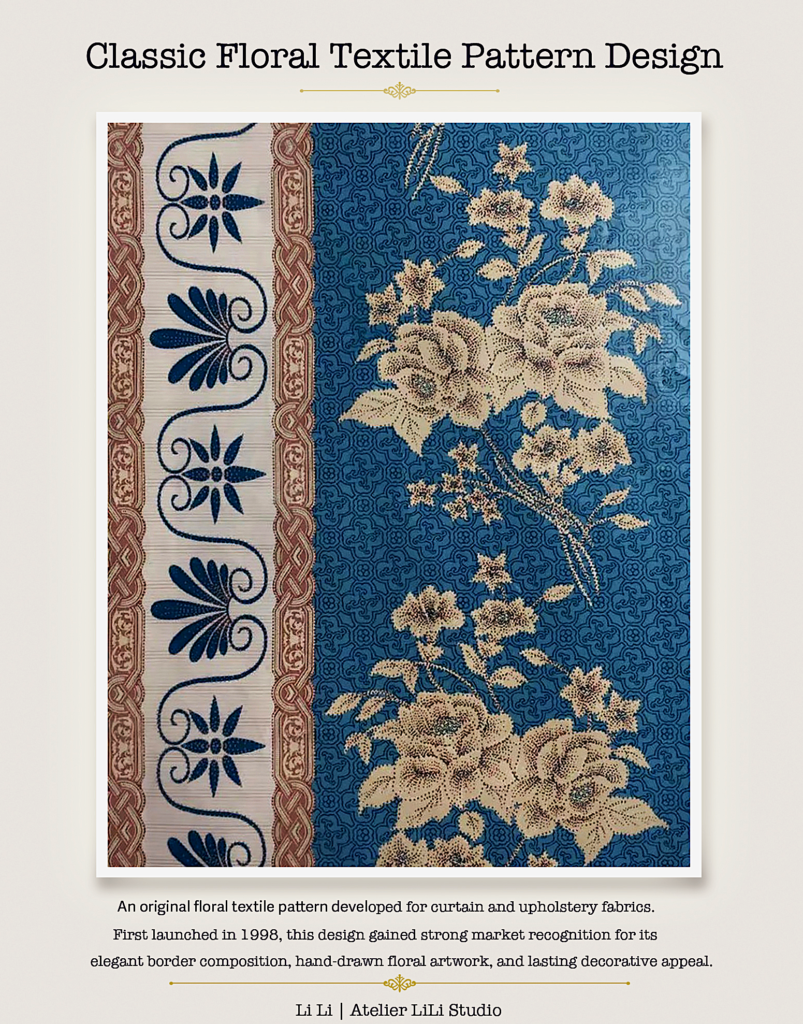
The million yuan sales result was one part of a longer change in my career. Several of my curtain, upholstery and home textile patterns became bestsellers. Some stayed in the market for years and inspired many imitations. Buyers began to recognize my abstract, colourful style. Business owners travelled from textile centres such as Keqiao and Shengze to visit my small studio in Hangzhou, China. Clients began coming to me.
That experience gave me a lasting respect for original design. A distinctive pattern helps customers recognize a product and gives a business something it can call its own. For clients, investing in textile design can build recognition over time and support sales in a direct, measurable way.
Textiles live very close to us. We wear them against our skin, sleep beneath them and use them to shape our homes. A preference for a flower, colour or texture may carry a memory or cultural association. I listen for those layers and translate them into a design that feels visually clear, technically appropriate and useful.
I invite clients to involve textile designers early. When material, use and people guide the same process, the finished product can be beautiful and useful, with a character of its own. That is the work I care about most. I want each textile to serve the business that makes it and the person who chooses it.
About LiLi Studio
Li Li is a Toronto-based designer and founder of Atelier LiLi Studio. Her career began in Hangzhou’s textile industry more than 20 years ago and later expanded to packaging design, visual branding, editorial graphics, e-commerce visuals and product development. Her work brings artistic sensitivity together with practical business experience, with a focus on textile-inspired design, thoughtful custom products, visual storytelling and the emotional value of everyday objects.