
By Juan Sebastián Batallas • June 2026
Automation promises efficiency, repeatability, and control. Across disciplines, from product design to architecture, from digital interfaces to fabrication labs, tools are increasingly capable of executing what we describe with remarkable accuracy. Yet the more automated our workflows become, the more visible something unexpected appears: the limits of abstraction.
Materials behave differently than models predict, systems encounter edge cases, and translation errors emerge between the digital and the physical. In these moments, it becomes clear that design intelligence was never located in the hand alone. Craft was never about manual skill alone. It was about judgment. I first understood this while working with robotic fabrication in timber.
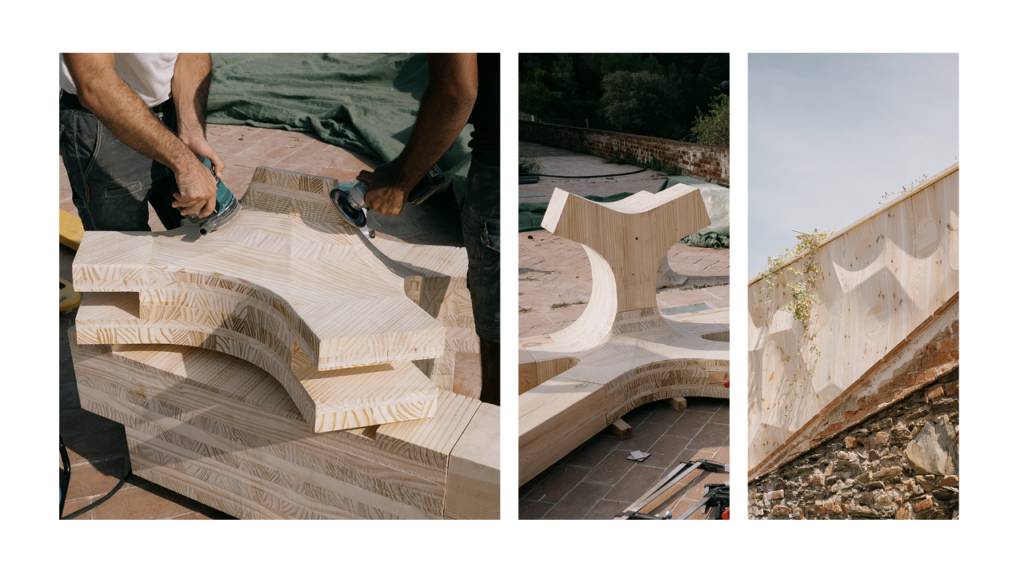
On screen, the geometry behaved perfectly: joints aligned, toolpaths flowed smoothly, and every element seemed resolved. But once the process moved from model to machine, new conditions emerged. The robotic arm approached configurations that produced kinematic singularities, the milling bit reacted to the direction of the grain, and small tolerances began to accumulate during assembly. None of these conditions appeared in the digital model. Automation had not eliminated uncertainty; it had simply relocated it. Moments like these reveal something important about craft.
Craft is the capacity to understand how a design travels from abstraction into reality. In automated workflows, that journey passes through layers of software, code, machines, and materials. Each layer translates the design in its own way. Singularities appear where geometry meets machine constraints, and tolerances accumulate where digital precision meets physical assembly. What we often call craft is the ability to read these situations, interpret them, and adjust the process before small discrepancies become structural problems.
Ideas move through models, models become code, code drives machines, and machines engage with materials that carry their own internal complexity. Each step introduces interpretation, and with it, the possibility of deviation. The work of the designer lies in understanding these translations, anticipating where they may distort the original intention and adjusting the system accordingly.
Sometimes they reveal possibilities that were never planned. A singularity, a material resistance, or a small mismatch between model and reality can produce outcomes that were never fully anticipated.
Automation does not remove the designer from the process; it multiplies the places where design judgment and discovery can occur. As our tools become more capable, the question is no longer whether automation will reshape design practice; it already has. What remains uncertain is how designers choose to position themselves within these systems.
If craft is understood as judgment across layers of abstraction and material reality, then automated workflows do not diminish its relevance; they expand its territory. Designers today must read algorithms, anticipate machine behaviour, and remain attentive to the intelligence embedded in materials themselves. The challenge is not to compete with automation, but to understand where our judgment continues to matter. Which returns us to the question we began with: where does craft live when machines execute the work?

About Juan Sebastián Batallas
Juan Sebastián Batallas is an architect based in Barcelona, working at the intersection of material craft, computational design, and digital fabrication. His work explores how emerging technologies, including robotics and parametric design, can engage with natural materials and ecological systems. He holds a Master’s in Advanced Ecological Buildings and Biocities from IAAC, where he contributed to the CORA (Cathedral of Robotic Artisans) project. He is currently developing an off-grid prefab cabin prototype, a project that tests how design intelligence travels from computational models into demanding physical terrain.