
By Anshika Agarwal • August 2026
The most common question every designer is asking right now is whether AI will replace them. I think that fear is rooted in a misunderstanding that has followed design for years: the idea that design is a tool-based skill. It never was. Design has always been about creative thinking, problem-solving, and empathy. We just happened to use tools to do it. Now the tools have changed, and some designers are confusing that shift for an identity threat.
Having worked across SaaS, government, fintech, and consulting in the pre-AI era and explored AI extensively with my clients, I can say this clearly: AI is not here to replace designers. It is here to push us to evolve. And the ones who embrace that are not just surviving. They are building things they could not have built before.
We are all builders now. With tools like Cursor, Claude, Figma Make and Stitch in the picture, designers can prototype faster, test new ideas earlier, and present end-to-end experiences to stakeholders without waiting weeks for engineering support. The gap between having an idea and showing it working has never been smaller. That is not a threat to the design role. That is the design role expanding.
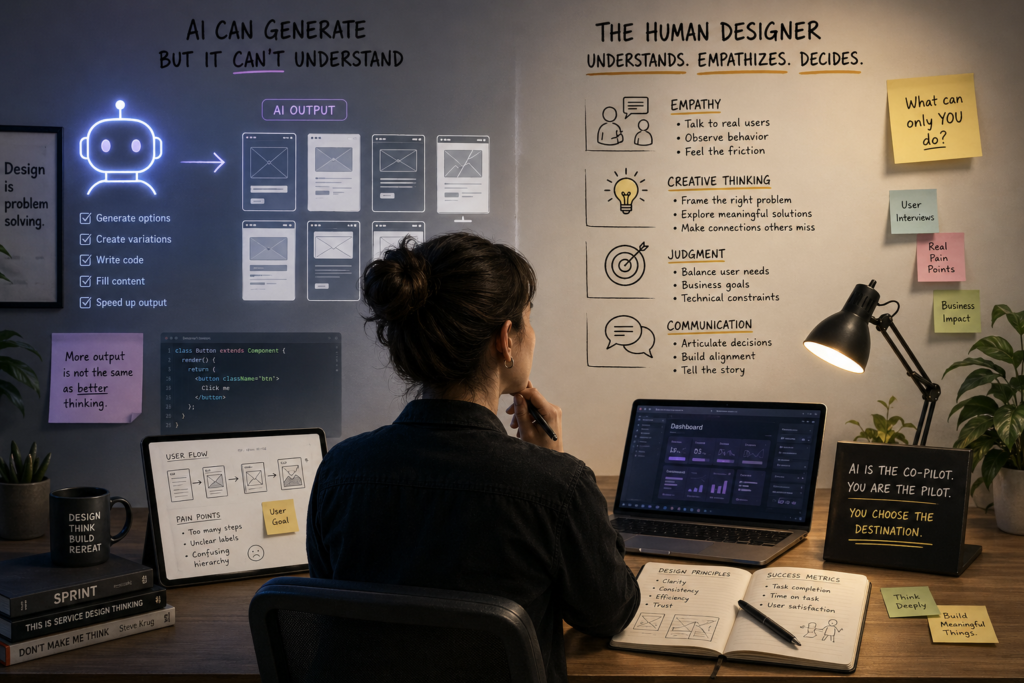
But there is a trap hiding inside all of that speed. When exploration becomes cheap, it can get shallow. You generate a dozen variants, pick the one that looks most polished, and call it divergent thinking. You have not actually thought more carefully. You have outsourced the discomfort of not knowing to a machine that is very good at looking confident. More output is not the same as better thinking.
And this is the one thing AI genuinely cannot replace: the creative thinking and empathy required to understand what a user is actually experiencing and build for their real pain points. AI can generate. It cannot feel the friction in a workflow. It cannot sit in a usability interview and notice the moment a user hesitates before clicking. It cannot weigh a design decision against a business objective and make the call. That judgment belongs to you.
The key is using AI smartly, not blindly. These tools still hallucinate. They have no institutional memory of why your team ruled something out three months ago, no awareness of your users, no understanding of what good looks like in your specific context. When you prompt without that context, you get generic output. The fix is treating AI like a capable new teammate who needs proper onboarding: share the research, the constraints, the decisions that shaped what already exists. A well-grounded prompt is worth a hundred vague ones.
AI tools should never be a blank slate. Your own thinking should always be the starting point. Use AI to implement your ideas, to pressure-test them, to build faster. But the ideas, the framing, the creative direction: that has to come from you first. The designers I know who are thriving right now are not the fastest generators. They are the most deliberate curators.
The best designers I know are still best at the things AI cannot touch: articulating design decisions and presenting them with conviction, applying design thinking principles across every stage of the process, ensuring design choices meet business objectives, and conducting usability interviews that surface what users actually struggle with. These are not soft skills sitting alongside the real work. They are the real work.
So instead of asking whether AI will replace you, ask a better question: what can only you do? The answer is everything that requires judgment, empathy, and real human understanding of the people you are designing for. AI is extraordinarily good at generating the next plausible step. It has no idea what the right destination looks like.

About Anshika Agarwal
Anshika Agarwal is a product and service designer with over five years of experience across consulting, fintech, SaaS, and government, designing digital products that are technically sound and human-centred. With an engineering background that lets her speak the language of both developers and stakeholders, she brings structure, empathy, and cross-functional fluency to every engagement. She runs her own design practice and is currently deepening her work in AI-powered design workflows, using tools like Cursor, Claude, and Figma MCP to go from design concept to testable, code-based prototypes faster than ever. She is also the host of Built Different Abroad, a podcast where immigrants talk openly about success, mindset, and staying fit while building a life in a new country.
One Response
What an amazing post! True, heartfelt, and grounded I’m reality! It instills calm in an era plagued by chaos!!