

By Takumi Inubushi • August 2026
Value judgment begins before information is processed.
This article is the first in a planned five-part series exploring how consumers make rapid judgments, perceive value, and move toward choice.
In many design discussions, we tend to focus on what a design communicates.
What message should be delivered?
Which information should be emphasized?
Which benefit should be explained?
These are important questions.
However, in real retail environments, consumers often begin judging a product before they read any explanation.
This is especially true in FMCG categories such as food, household goods, beverages, and personal care. In these environments, many products compete for attention within a very limited amount of time. Consumers do not carefully read every ingredient, feature, or claim before forming an initial impression.
And yet, within just a few seconds, people begin to estimate value.
“This looks premium.”
“This feels trustworthy.”
“This seems high quality.”
“This might be right for me.”
These judgments can happen before conscious comparison. They may occur unconsciously, based on visual cues rather than verbal information.
Through many years of working in packaging design, I have come to see design not simply as decoration or information arrangement, but as something that helps people move from perception to judgment, and from judgment to choice.
When we observe what happens at the shelf, consumers seem to pass through several stages almost instantly.
First, does the product enter their field of vision?
Second, do they understand what kind of product it is?
Third, does it feel credible enough to consider?
In other words, before a product is chosen, it may need to pass through several gates:
Here, “trust” does not only mean trust in a company. In packaging, it can include brand memory, category expectations, quality cues, functional claims, and previous experiences with similar products. It is the feeling that “this product may be worth considering.”
What is interesting is that many of these judgments begin before explanation.
A package is not only read. It is first perceived.
Another important point is that value judgment is not universal.
For example, in some Western market contexts, white space and simplicity may communicate premium value. In some Japanese categories, however, detailed information, careful explanation, and quality cues may contribute to reassurance and trust.
This suggests that consumers are not simply looking at the product itself. They may be making rapid judgments based on value standards accumulated through past experience and culture.
Everyday landscapes, education, communication styles, shopping experiences, and repeated exposure to visual conventions can all shape what people come to perceive as “high quality,” “safe,” or “trustworthy.”
Design, therefore, is not only the skill of making something look beautiful.
It is also the practice of understanding how people perceive value, make unconscious judgments, and move toward choice.
To design more effective packaging, we need to look not only at what we want to communicate, but also at what consumers may be judging before they read.
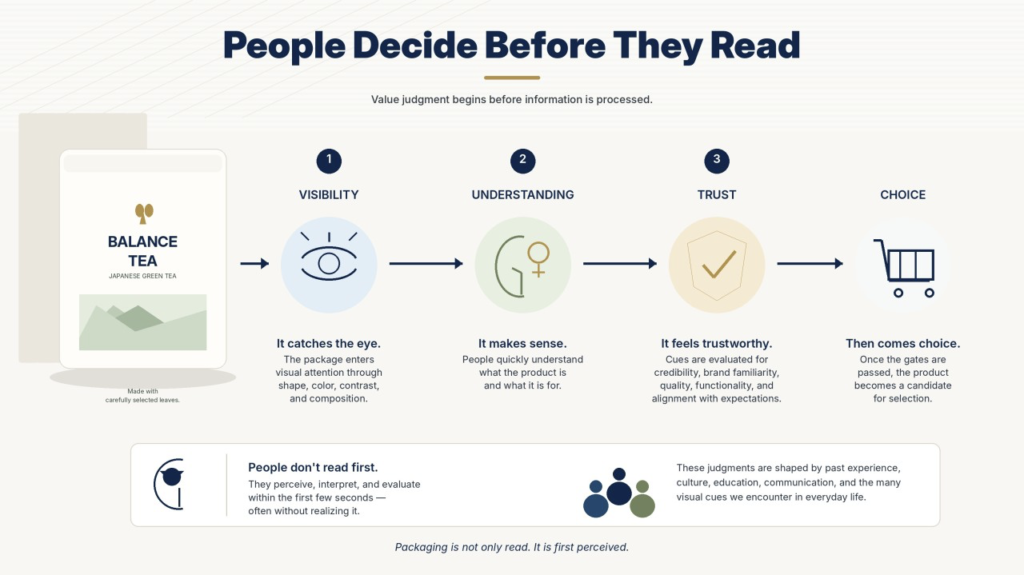
In the next article, I will explore the three gates of choice in more detail:

About Takumi Inubushi
Takumi Inubushi is a Creative Director specializing in FMCG packaging and brand design. He explores how consumers make rapid decisions through visual signals, cultural memory, and packaging structure.