
By Celine Hong • May 2026
“If you have any other questions, let me know. I have a good picture of it all, so don’t hesitate to reach out.” I replied with my thanks before leaving the virtual meeting. It was an unsurprising end to an interest-holder interview. I didn’t know it at the time, but that moment would spark a lot of reflection about the Service Design process I follow.
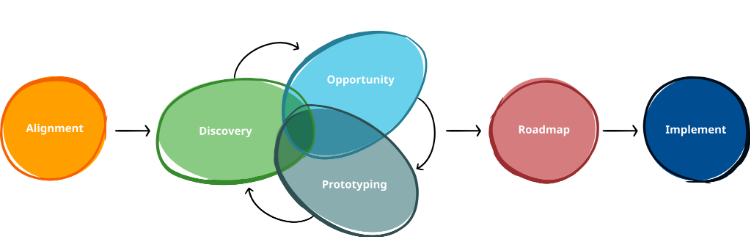
Not as popular as UX, you might not immediately recognize the term Service Design. Even for those who have never heard of it, the Service Design process will sound familiar. Every organization puts its own spin on it, but it typically goes something like: Alignment, then Discovery, Opportunity Identification, Prototyping & Testing, and ending with Road-mapping and Implementation. When I joined the BC Public Service, this is how I started to define the stages of my work. Despite some variation, the foundation is the same process taught for decades in
design schools.
You might not immediately recognize the term Service Design. It was only after joining the BC Public Service, that I defined my work through the formal process myself. Even for those who have never heard of it, the Service Design process will sound familiar. First Alignment, then Discovery, Opportunity Identification, Prototyping & Testing, and ending with Road-mapping and Implementation. Every organization puts its own spin on it. Despite the tweaks, the foundation is the same process taught for decades in design schools.
Reflecting on the last year, many of the projects I’ve worked on have focused on the early Discovery work. I spent a lot of time planning research, recruiting interest-holders and end-users alike. I facilitated workshops and interviews. I synthesized notes. I created slide decks to share insights with our partners and their executives. In any presentation, I hoped people left impressed with the value of design research. It felt like championing design.
While preparing insights from my most recent round of research, I returned to my notes. “If you have any questions… don’t hesitate to reach out”. Seeing it again triggered a sense of unease I couldn’t immediately explain. It would linger for days before I could articulate what bothered me.
When I found the words, they formed a question:
Why am I calling this “Discovery”? As if I’m some pioneering colonist, getting recognition for documenting what others have known about for years. Things they understand with a depth I’ll never have.
You can argue that I’m too focused on semantics. Or that it doesn’t matter in the end what something is called. Why toss out such established and recognized terminology for the sake of an icky feeling?
My concern isn’t the adoption of a new term throughout the design community. It is about the way our words reflect back on us, our roles and responsibilities as designers. We are not going to “discover” anything that someone else doesn’t know. Users and interest-holders are very aware of their challenges. We will never know any context with the detail and nuance of the people who are in it every day. What we can do is use our positions to elevate the voices and knowledge of others. Share their experiences with an audience they don’t have the time or responsibility to report to themselves. We can inform executives and decision-makers of the perspectives that matter most, and it is not our own.
Language shapes how we see our role. By reframing “discovery,” we remember to de-centre ourselves and instead credit the voices already present.

About Celine Hong
Celine Hong is an optimist, outdoor enthusiast, and designer with a love of the craft. I studied at Emily Carr University of Art and Design, before designing interactive exhibits. I currently work for the BC Public Service as a Design Lead.
I’m located in Vancouver, BC, on the unceded, ancestral territories of the xʷməθkʷəy̓əm (Musqueam), Sḵwx̱wú7mesh (Squamish) and sə̓lílwətaʔɬ (Tsleil-Waututh) Nations.