
By Rebecca Kim • May 2026
Empathy mapping is one of those UX tools almost every designer has used — and quietly questioned.
We’ve all been there: a workshop gets scheduled, sticky notes go up, quadrants get filled, and for a moment, everyone feels aligned. Then the meeting ends, the artifact gets saved somewhere, and the team moves on to journeys, features, or delivery. The empathy map exists — but its influence fades fast.
Earlier this year, I facilitated a hands-on Persona Empathy Mapping workshop with a design team. Going into it, I wasn’t interested in producing a “great” artifact. I was interested in something harder: making empathy useful beyond the workshop itself.
This article kicks off a three-part series on how empathy mapping can move from a familiar UX exercise to a strategic input — one that supports clearer decisions, stronger alignment, and real business conversations.
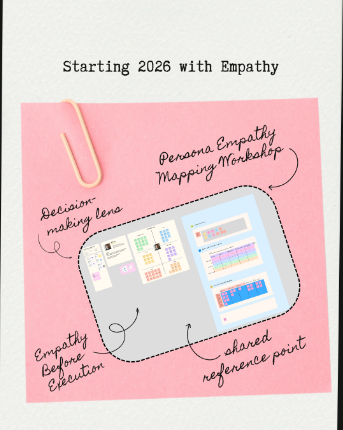
Most empathy maps don’t fail because they’re wrong. They fail because they stop at description.
When empathy works only inside UX artifacts, it rarely shows up where it counts most: prioritization, trade-offs, and strategy discussions.
In this workshop, we reframed empathy mapping as sense-making, not documentation. Instead of asking, “What does the user feel?”
That shift changed the energy in the room. Designers stopped trying to be exhaustive and started looking for signals — moments that hint at drop-off, disengagement, or lost trust.
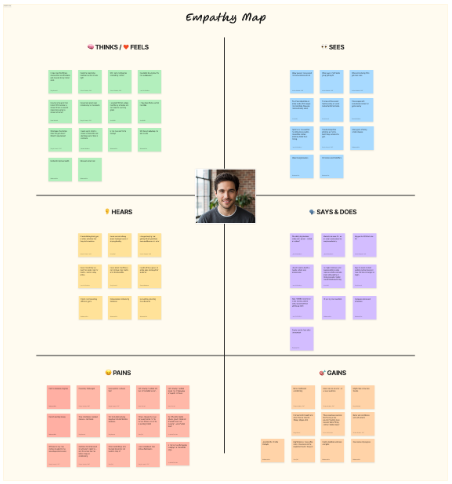
Those emotional and cognitive moments aren’t just UX concerns. They’re early indicators of outcomes product teams care deeply about:
When users hesitate, second-guess, or feel uncertain, it often shows up later as churn, lowadoption, or poor engagement — even if the UI itself is usable.
Empathy mapping, when used intentionally, helps teams spot those risks early — before solutions harden and roadmaps lock in.
Empathy mapping is only the first step. The real work begins after the workshop, when teams are faced with a wall of observations and the question: “So what?”
In the next article, I’ll share how we moved from raw empathy insights to clear opportunity areas — and how reducing insight clutter made the work more actionable for both design and product partners.

About Rebecca Kim
Rebecca Kim is a Lead Product Designer and UX leader with over 15 years of experience across B2B and B2C products on mobile, web, and emerging platforms. She’s worked in telecom, finance, technology, and media, and enjoys helping teams turn messy qualitative insights into clear product direction. Her work focuses on empathy-
driven UX and service design strategy, partnering closely with design and product teams to drive adoption, retention, and long-term customer and business value. She’s also active in the design community as the IxDF Canada Country Manager.