
By Marie Lauriane Khoury • June 2026
In a field that constantly encourages reduction, I found myself moving toward accumulation, not to complicate things, but to stay honest to how I think and create.
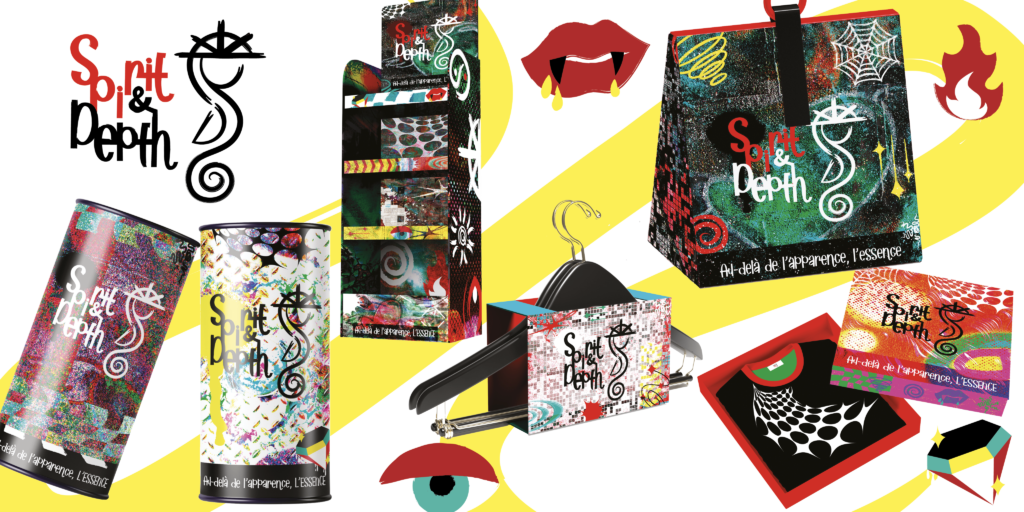
Design is often taught as an exercise in restraint. Remove what is unnecessary, focus on what matters, and build clarity through simplification. This logic is effective, but it also assumes that every message can be reduced without losing something essential. In my experience, that is not always the case. Some ideas resist simplification, not because they are unclear, but because they are made of multiple parts that only make sense together. This is where my interest in maximalism began, not as a rejection of design principles, but as an expansion of them.
My work tends to include a high level of visual information. I use strong colours, layered compositions, and a mix of elements that interact within the same space. This is not about filling space for the sake of it, but about building a visual environment where different aspects of an idea can exist at once. Instead of selecting a single focal point and discarding the rest, I allow multiple entry points into the image. The viewer is not guided in one fixed direction, but invited to navigate the composition more freely. This approach has also become a way for me to stand apart by embracing visual complexity in a context that often prioritizes reduction.
This approach reflects the way I process things. I do not experience ideas in isolation. They appear connected, influenced by context, memory, and emotion at the same time. Trying to translate that into a simplified visual often feels incomplete. By working with accumulation, I can retain more of that initial complexity without forcing it into a format that does not fit. What might seem overwhelming at first glance is actually structured, with relationships between elements that create an underlying coherence.
Minimalism is widely valued because it delivers information quickly and clearly. However, speed and clarity are not always the primary goals. Some visuals are meant to be explored rather than instantly understood. By introducing more elements, repetition, and contrast, maximalism can slow down the viewing process and create a more engaging interaction. It allows the image to unfold over time, revealing different details depending on where the viewer chooses to focus. In that sense, maximalism becomes not only a stylistic choice but a positioning, a way to offer a different visual experience in a landscape that often looks the same.
Working this way is often misunderstood as a lack of control, when in reality it requires careful decisions. Every addition affects balance, rhythm, and readability. The challenge is not to reduce, but to organize. This has pushed me to become more precise in how I place, scale, and connect elements within a composition. It has also strengthened my ability to manage complexity without losing direction. It is through this tension between freedom and structure that I have been able to develop a more distinctive visual voice.
Maximalism is not about excess for its own sake. It is about making space for multiple ideas to coexist without forcing them into a single, simplified version. In doing so, it offers another way to approach design, one that values depth, exploration, and layered meaning. Rather than removing until something works, it asks a different question: how much can be kept, and still remain coherent?
About Marie Lauriane Khoury
Marie Lauriane Khoury is a graphic designer and multidisciplinary artist based in Montréal, with a background in both academic and applied design. She works across illustration, branding, and visual communication, combining technical knowledge with a strong artistic sensibility. Her practice evolves through a balance of structured design work, her diverse cultural background, and more experimental personal projects, shaping a visual identity that is both versatile and distinctive.